Tank-fed
Tank-fed countertop dishwasher
Best to investigate when faucet compatibility is uncertain or you want to avoid a continuous faucet connection. Check fill access, drain routing, counter space, power, and capacity.
Renter kitchen · decision guide
A countertop dishwasher can solve a real small-kitchen problem, but the first decision is not which model has the most wash cycles.
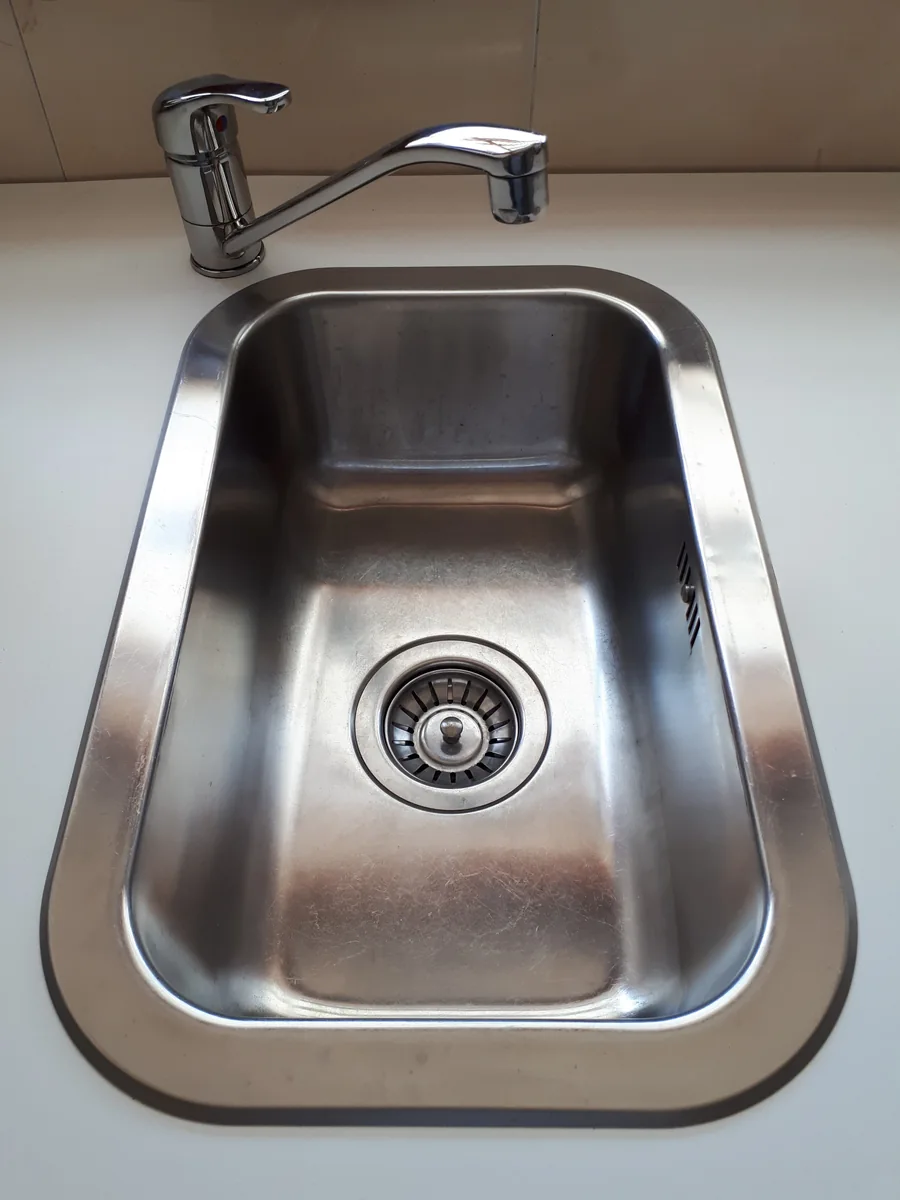
The first decision is whether the complete setup works in your kitchen.
That means checking the space the machine occupies while it is being loaded and used, how water gets into it, where wastewater goes, what electrical setup the exact model requires, and whether the dishes you actually use fit inside.
A model can be compact and still be a poor fit if it blocks prep space, cannot sit below your upper cabinets, needs a faucet connection your sink cannot support, or leaves you with an awkward drain-hose routine.
Quick decision
If one of those answers is still unknown, resolve it before comparing extra programs or convenience features.
Water-source decision flow
01 · Complete working footprint
The outside dimensions are only the beginning. A countertop dishwasher also needs working space. You may need room above the machine to fill a built-in tank, room in front to open the door, space beside it for hoses, and a practical route to the sink or drain destination.
For example, current Midea countertop models show how different two products in the same category can be. The MDC17P4CWW is listed at 17.5 inches deep, 16.5 inches wide, and 18.4 inches high. The larger MDC22P1AWW is listed at 19.7 inches deep, 21.7 inches wide, and 17.2 inches high.
Those are model-specific dimensions, not category standards. Use them as examples of why measuring the real setup matters.
02 · Water-source architecture
Countertop dishwashers can create very different daily routines depending on how they receive water. One current architecture uses a built-in tank that you fill before the cycle. Another connects to the kitchen faucet. Some machines support both methods.
The Midea MDC17P4CWW, for example, can use its built-in 5-liter tank or connect to a faucet with the supplied connection hardware. The MDC22P1AWW is a larger faucet-connected example.
A built-in tank may reduce dependence on faucet compatibility, but you still need to fill the machine, provide a drain route, keep the machine level and accessible, and meet its electrical requirements. A faucet-connected unit avoids repeated manual filling, but the exact adapter and faucet combination must work together, and the machine needs a practical hose route while it is running.
Avoid this shortcut: Do not assume that “portable” means “works with every sink.”
03–05 · Connection, drain, electrical
| Check | Confirmed | Check exact model | Unresolved |
|---|---|---|---|
| Counter footprint / upper clearance / door clearance | Measure actual kitchen | Published dimensions | Pause comparison |
| Water source / faucet requirement | Tank, faucet, or both | Adapter and hose requirements | Pause comparison |
| Drain route / electrical | Destination and outlet location | Manual instructions | Pause comparison |
| Capacity | Real dishes compared | Rack and capacity limits | Compare last |
A faucet hookup is a product-specific installation question. Before buying a faucet-connected model, check the manufacturer documentation for included adapter or quick-connect hardware; faucet requirements; inlet-hose length and routing; any restrictions that apply to the connection; and how often you expect to attach and remove it.
Pull-down, pull-out, specialty, or otherwise unusual faucets may create different constraints than a conventional removable-aerator setup. Do not infer compatibility from photos alone. If you are not sure, treat faucet compatibility as unresolved rather than assuming an adapter will solve it.
Water has to leave the machine somewhere every time it runs. A drain hose that technically reaches the sink is not automatically a good routine. Think about where it will sit, how it will stay in place, whether it interferes with normal sink use, and whether the route can remain stable during a cycle.
The Midea MDC17P4CWW manual, for example, describes routing the drainpipe to a sink drain or an appropriate bucket and securing the hose as directed. That is a model-specific example. It does not establish that every sink, bucket, counter height, or apartment setup is suitable.
Do not generalize electrical requirements across countertop dishwashers. The MDC17P4CWW manual specifies 120V AC at 60Hz and a 10-amp circuit for that model. Another dishwasher may have different requirements.
Check the exact product documentation and confirm voltage and circuit information; outlet location; cord reach; whether the manufacturer's installation instructions restrict extension cords or adapters; and whether the outlet remains accessible in the intended setup. A nearby outlet is not proof that the electrical setup is appropriate.
06 · Capacity
Place-setting numbers are useful only if they match your routine. Current countertop examples range from very small two-place-setting designs to larger six-place-setting machines. But the useful question is whether your plates, bowls, glasses, utensils, and commonly used cookware fit.
A larger machine may reduce the number of cycles but require more counter space and a different water setup. A smaller tank-fed machine may be easier to place but require more frequent loading. Capacity is a tradeoff, not a universal ranking.
07 · Rental constraints
Manufacturer documentation tells you how a machine is designed to be installed and used. It does not tell you whether your lease, landlord, building, insurer, or local rules permit the setup.
If your rental has restrictions on countertop appliances, temporary faucet connections, water-damage responsibility, or appliance placement, verify those separately. Do not treat “no permanent plumbing” as equivalent to “automatically allowed.”
Product archetypes to compare
Tank-fed
Best to investigate when faucet compatibility is uncertain or you want to avoid a continuous faucet connection. Check fill access, drain routing, counter space, power, and capacity.
Faucet-connected
Best to investigate when a compatible faucet and sink-adjacent position are available. Check the exact adapter, hose route, drain route, counter footprint, and capacity.
Dual-mode
Best to investigate when you want flexibility between manual filling and a faucet connection. Confirm that both methods are actually supported by the exact model and documentation.
Candidate after setup checks
This guide directly references its built-in 5-liter tank or faucet-connection setup; compare it only after counter clearance, hose routing, drainage, and power fit are confirmed.
View on Amazon Affiliate linkFinal fit checklist
Evidence and limitations
This guide uses current manufacturer documentation to explain the decision factors that should be checked before buying. Product dimensions, electrical requirements, connection hardware, capacity, drain instructions, and installation limits are model-specific.
Routine & Room has not performed hands-on testing of the products referenced here. This guide does not establish lease approval, universal plumbing compatibility, universal electrical suitability, or guaranteed cleaning or drying performance.
Affiliate links are active for the named product candidate. Read the affiliate disclosure and Amazon Associate identification.